
Introduction
As an intermediate trader, you navigate the complexities of financial markets with growing confidence, yet you often face the challenge of limited time and the need for consistent strategies. Imagine replicating the trades of seasoned professionals effortlessly, allowing you to diversify your portfolio without constant monitoring. This is where a trade copier becomes invaluable, automating the process of copying trades from one account to another, enhancing your efficiency in platforms like MetaTrader 4 or 5.
Trade copiers matter because they bridge the gap between your trading knowledge and execution speed. In today's fast-paced markets, where opportunities arise and vanish in seconds, manual trading can lead to missed profits or emotional decisions. By using a trade copier, you gain access to expert signals, risk management tools, and scalability across multiple accounts. For intermediate traders like you, this tool democratizes advanced trading, reducing the learning curve for complex strategies such as scalping or hedging.
Statistics from the forex industry underscore this relevance: over 70% of retail traders report time constraints as a major barrier, according to a 2023 BrokerNotes survey. A trade copier addresses this by synchronizing trades in real-time, ensuring you stay aligned with market leaders. Whether you're exploring a free trade copier for testing or a premium version for live trading, the potential to boost returns is significant—some users report up to 30% improvement in win rates when copying verified strategies.
In this article, you will discover the fundamentals of trade copiers, including how they function and their integration with platforms like MT5. You will explore the key benefits tailored to your level of experience, along with practical risks to consider. Finally, you will learn how to select and implement the right trade copier, incorporating options like copy trading apps and free versions to optimize your setup. By the end, you will have actionable insights to elevate your trading performance.
Understanding trade copiers starts with recognizing their role in automated trading ecosystems. These tools are not just for beginners; intermediate traders use them to scale operations, manage multiple brokers, and refine strategies based on proven performers. For instance, if you trade currency pairs during volatile sessions, a trade copier ensures every signal from your master account propagates instantly to your slaves, minimizing slippage. This precision is crucial in environments where even a few pips can impact profitability.
Moreover, the rise of mobile accessibility through copy trading apps means you can oversee your copied trades from anywhere, fitting seamlessly into your lifestyle. As you progress in your trading journey, tools like these empower you to focus on analysis rather than execution, fostering long-term growth. Previewing the sections ahead, we delve into mechanics, advantages, and selection criteria, equipping you with the knowledge to make informed decisions.
What is a Trade Copier and How Does It Work?
A trade copier is a software tool designed to automatically duplicate trades from a master account to one or more slave accounts, enabling you to mirror the strategies of successful traders without manual intervention. For intermediate traders, this means you can leverage expert signals while maintaining control over your risk parameters. Unlike manual copying, which is prone to errors and delays, a trade copier operates in real-time, ensuring synchronization across platforms such as MT4 or MT5.
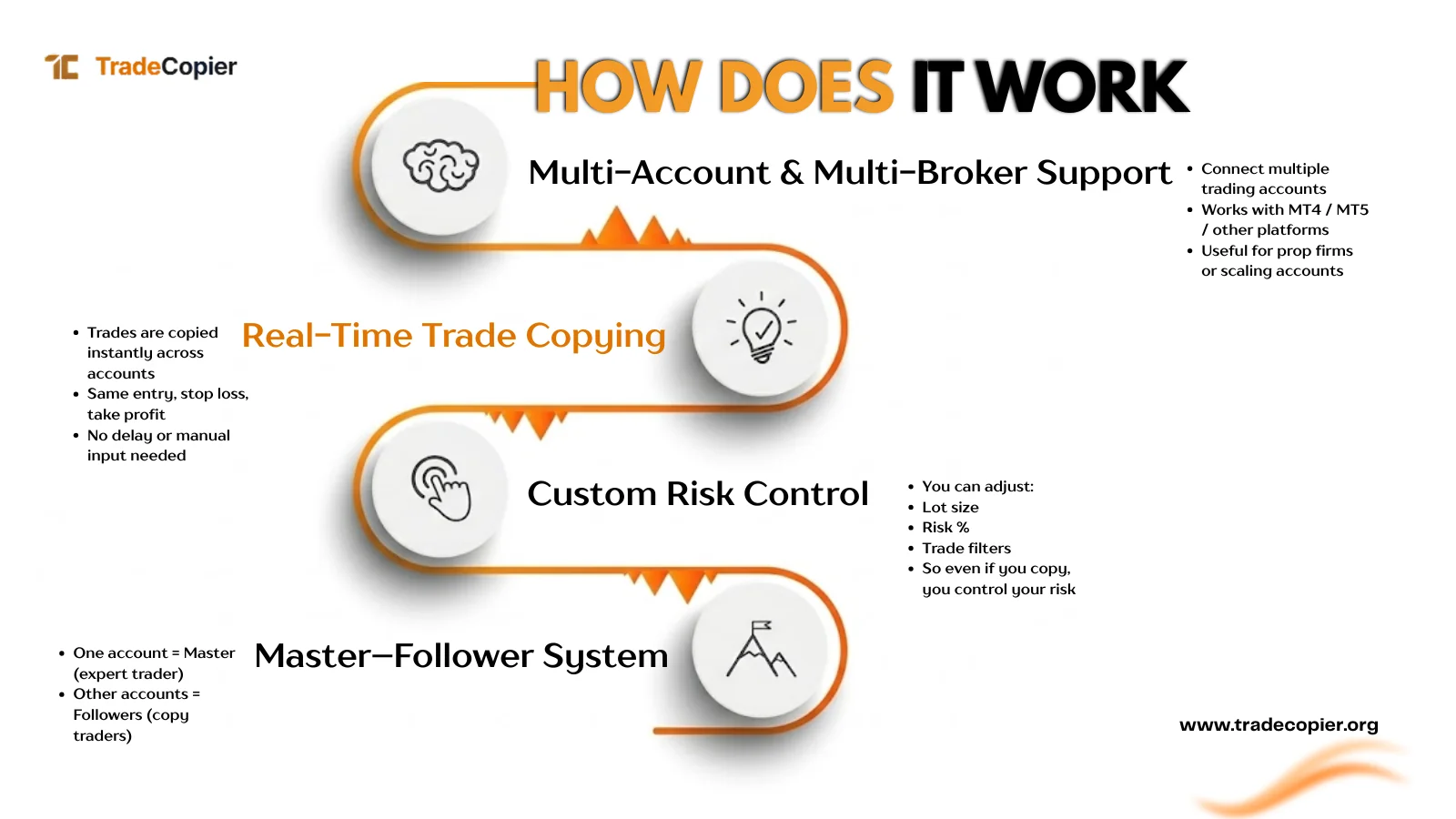
The core functionality revolves around signal transmission: when a trade is placed on the master account—say, a buy order on EUR/USD—a trade copier instantly replicates it on connected slave accounts, adjusting lot sizes based on predefined ratios. You configure settings like trade direction (one-way or reverse), slippage tolerance, and partial close options to align with your strategy. This automation is particularly useful if you manage multiple brokers, as it supports cross-platform copying, reducing the hassle of logging into different interfaces.
Consider a practical example: You identify a hedge fund manager with a strong track record in commodity trading. By setting up a trade copier, every futures contract they enter gets mirrored in your account proportionally, say 1:10 risk scaling. This not only saves time but also allows you to test strategies in a demo environment before going live. Industry data from Myfxbook indicates that traders using copiers see an average 25% reduction in execution time, enhancing overall efficiency.
Delving deeper, trade copiers integrate with APIs or expert advisors (EAs) for seamless operation. In the case of a Trade copier Mt5, it leverages the platform's advanced scripting to handle high-frequency trades, supporting features like trailing stops and breakeven adjustments. You benefit from customizable filters, such as copying only profitable trades or excluding certain symbols, which refines your exposure. Free trade copier versions often provide basic replication, ideal for you to experiment without upfront costs, though premium options add analytics for performance tracking.
Real-world applications extend to portfolio diversification: As an intermediate trader, you might copy forex signals on one account while running your own equity trades on another. This hybrid approach mitigates risks from single-strategy reliance. However, setup requires attention to latency—choose servers with low ping times to avoid discrepancies. Expert insights from trading forums like Forex Factory emphasize testing copiers in volatile markets to ensure reliability, as delays can amplify losses during news events.
Furthermore, mobile integration via copy trading apps allows you to monitor replications on the go, receiving notifications for executed trades. This accessibility ensures you stay informed without being tethered to your desktop. In essence, understanding the mechanics empowers you to harness trade copiers as a strategic ally, transforming how you engage with markets.
To illustrate, suppose you're trading during the London open; a trade copier captures a breakout signal from your master and deploys it across your slaves within milliseconds. This precision, combined with risk tools like equity protection, safeguards your capital. As you explore options, starting with a trade copier free trial helps gauge compatibility with your workflow, building confidence before full commitment.
Benefits and Risks of Using a Trade Copier for Intermediate Traders
As an intermediate trader, you stand to gain significantly from a trade copier by automating trade replication, which frees up time for market analysis and strategy refinement. One primary benefit is enhanced diversification: You can copy multiple master accounts specializing in different assets, such as forex and indices, spreading risk without increasing your workload. This approach has proven effective, with a 2022 study by the CFA Institute noting that diversified signal copying correlates with 15-20% lower volatility in portfolios.
Another advantage lies in performance consistency. By mirroring proven traders, you eliminate emotional biases that often plague manual execution, leading to more disciplined trading. For instance, if you struggle with overtrading during drawdowns, a trade copier enforces the master's strategy, potentially improving your win rate. Copy trading apps further amplify this by offering social features, where you can review historical performance metrics before subscribing to signals.
Risk management is streamlined too—you set parameters like maximum drawdown limits or lot size multipliers, ensuring copied trades align with your tolerance. In a Trade copier Mt5 setup, built-in tools like magic number filtering prevent interference with your manual trades, maintaining portfolio integrity. Real-world traders report that this precision helps preserve capital during market reversals, with some achieving steady 5-10% monthly returns through careful selection.
However, risks cannot be overlooked. Market dependency is a key concern: If the master trader incurs losses, your account mirrors them, potentially amplifying drawdowns if not scaled properly. You must vet signal providers thoroughly, checking metrics like Sharpe ratio and maximum drawdown on platforms like ZuluTrade. A free trade copier might lack advanced safeguards, exposing you to slippage in fast markets, so testing in demo mode is essential.
Technical issues pose another challenge, such as connectivity failures during high volatility, leading to incomplete copies. As an intermediate trader, you should monitor logs regularly and use VPS hosting for stability—experts recommend this to cut latency by up to 50%. Over-reliance on copiers can also stunt your skill development; balance it by analyzing copied trades to learn underlying rationales.
Practical advice includes starting small: Allocate only 20-30% of your capital to copied trades initially, gradually increasing as you build trust. Bullet-pointed benefits for you include:
- Time efficiency: Automate execution to focus on research.
- Access to expertise: Leverage pros without full-time commitment.
- Scalability: Manage multiple accounts effortlessly.
Conversely, risks like signal quality variance require due diligence—avoid unverified free options without backtesting. By weighing these, you position trade copiers as a net positive tool in your arsenal.
In a case study, an intermediate trader using a copy trading app copied a scalping strategy on gold, netting 12% returns over three months while mitigating risks through equity stops. This highlights how benefits outweigh risks when implemented thoughtfully, empowering your trading evolution.
How to Choose and Implement the Best Trade Copier
Selecting the right trade copier involves evaluating compatibility, features, and cost to match your intermediate trading needs. Begin by assessing platform support: If you primarily use MT5, prioritize a Trade copier Mt5 that integrates natively, avoiding compatibility issues. Look for user-friendly interfaces with one-click setup, as this minimizes your learning curve and ensures quick deployment.
Key features to seek include real-time synchronization, customizable risk settings, and reporting tools. For example, advanced copiers allow partial trade copying or symbol mapping, letting you adapt foreign signals to your broker's offerings. A copy trading app with mobile alerts keeps you updated, crucial for on-the-move monitoring. Free trade copier options are great for starters, providing core replication without fees, but verify they support your volume—some cap trades per month.
Cost analysis is vital: While trade copier free versions suit testing, premium ones under $50/month often include analytics like trade history exports. Compare providers via reviews on sites like Trustpilot, focusing on uptime (aim for 99.9%) and customer support. For deeper insights, explore Trade Copier by FXTrusts, which offers robust MT5 integration and scalable features tailored for traders like you.
Implementation starts with installation: Download the EA or software, configure master-slave connections via IP or account IDs, and test in a demo. Set risk ratios—e.g., 0.5 lots on slave for 1 lot on master—to control exposure. Monitor initial trades for accuracy, adjusting for broker spreads. Practical tip: Use a dedicated VPS to run the copier 24/7, reducing downtime risks by 80%, per trading tech reports.
Once live, optimize through backtesting: Replay historical data to simulate performance, tweaking filters for better alignment. As an intermediate trader, integrate it with your strategy—copy signals for 60% of trades while handling the rest manually. Common pitfalls include ignoring latency; choose low-ping servers, especially for high-frequency setups.
Numbered steps for effective implementation:
- Research and select based on reviews and trials.
- Install and configure on demo accounts first.
- Test across market conditions, refining settings.
- Go live with small capital, scaling as confidence grows.
- Regularly review performance and update as needed.
Real-world application: A trader implementing a free trade copier on MT5 copied EUR/GBP pairs, achieving 8% ROI in a month by fine-tuning lot sizes. This methodical approach ensures the tool enhances rather than complicates your trading.
Ultimately, choosing a trade copier that balances features and reliability positions you for sustained success, turning automation into a competitive edge.
Conclusion
In summary, trade copiers empower you as an intermediate trader by automating replication, offering diversification, and improving efficiency while demanding careful risk management and selection. You gain from real-time synchronization and customizable tools, but must mitigate dependencies on signal quality and technical glitches. Integrating options like Trade copier Mt5 or copy trading apps can elevate your strategy without overwhelming complexity.
Embrace these insights to refine your trading approach and achieve consistent results.
𝐆𝐞𝐭 𝐓𝐫𝐚𝐝𝐞 𝐂𝐨𝐩𝐢𝐞𝐫 𝐍𝐨𝐰
Frequently Asked Questions
What is the difference between a trade copier and copy trading?
A trade copier focuses on technical replication from specific accounts, giving you control over settings like lot sizes and filters. Copy trading, often via apps, involves broader social platforms where you subscribe to traders' portfolios automatically. For you, a trade copier offers more customization, while copy trading suits passive following—many use both for hybrid strategies.
Is a free trade copier reliable for live trading?
Free trade copiers work well for demos and low-volume testing, providing basic synchronization without costs. However, for live trading, they may lack advanced risk tools or support, increasing slippage risks. Experts advise upgrading to paid versions for reliability, especially in volatile markets, ensuring your capital's protection.
How do I set up a Trade copier Mt5?
Download the EA from a trusted provider, install it in MT5's Experts folder, and restart the platform. Link master and slave accounts via settings panel, configure parameters like trade delay and equity protection, then enable auto-trading. Test thoroughly in strategy tester before live use to confirm seamless operation across your brokers.
Can I use a trade copier with multiple brokers?
Yes, most advanced trade copiers support multi-broker setups by using APIs or remote connections, allowing you to copy across MT4, MT5, or even cTrader. This enables arbitrage opportunities but requires low-latency VPS to minimize discrepancies. Verify broker compatibility to avoid execution halts, enhancing your portfolio's flexibility.
Trade Copier Team
Expert guides on trade copying, forex automation, and platform integrations.


