A trade copier checklist helps traders verify configuration before live use. It focuses on rule compliance, account setup, and ongoing monitoring to support consistent replication. Checking prop firm rules first reduces the chance of violations. Allocation settings and risk parameters must match each account's requirements. Regular reviews of copier logs and position states catch divergence early.
What should traders check before using a trade copier?
Reviewing prop firm rules forms the first step in any trade copier checklist. Each firm sets daily loss limits, trailing drawdown rules, and consistency requirements that the copier must respect. Source 1 lists per-account daily loss limits with hard lockout and trailing drawdown monitoring as essential features.
Platform compatibility and connection type come next. NinjaTrader, Tradovate, and Rithmic connections require separate configuration for each account. Source 3 notes that accounts connect independently and must show connected status before replication begins.
Symbol mapping and contract ratios also require verification. Followers may need micro contracts such as MES or MNQ when the leader uses full-size instruments. Cross-instrument mapping prevents size mismatches across accounts of different capital levels.
How should allocation rules be configured for account replication?
Allocation rules convert master trade size into follower trade size. Fixed multipliers work only when accounts hold similar equity. Equity-ratio scaling adjusts lots according to each follower balance relative to the master. Source 4 identifies lot-size multipliers and percentage-based risk as common parameters.
Risk-based scaling offers another option. The copier calculates lot size from the master stop distance and each follower's chosen risk percentage. This approach keeps risk consistent even when account sizes differ.
Per-account limits prevent one follower from breaching its own thresholds. Daily loss limits and profit-target pauses should be set individually rather than globally. Source 3 recommends buffers below firm limits to allow for slippage.
How should copier settings be monitored?
Position reconciliation checks that follower positions match master positions after every fill. Discrepancies from partial fills or manual intervention require immediate correction. Continuous state monitoring reduces drift between accounts.
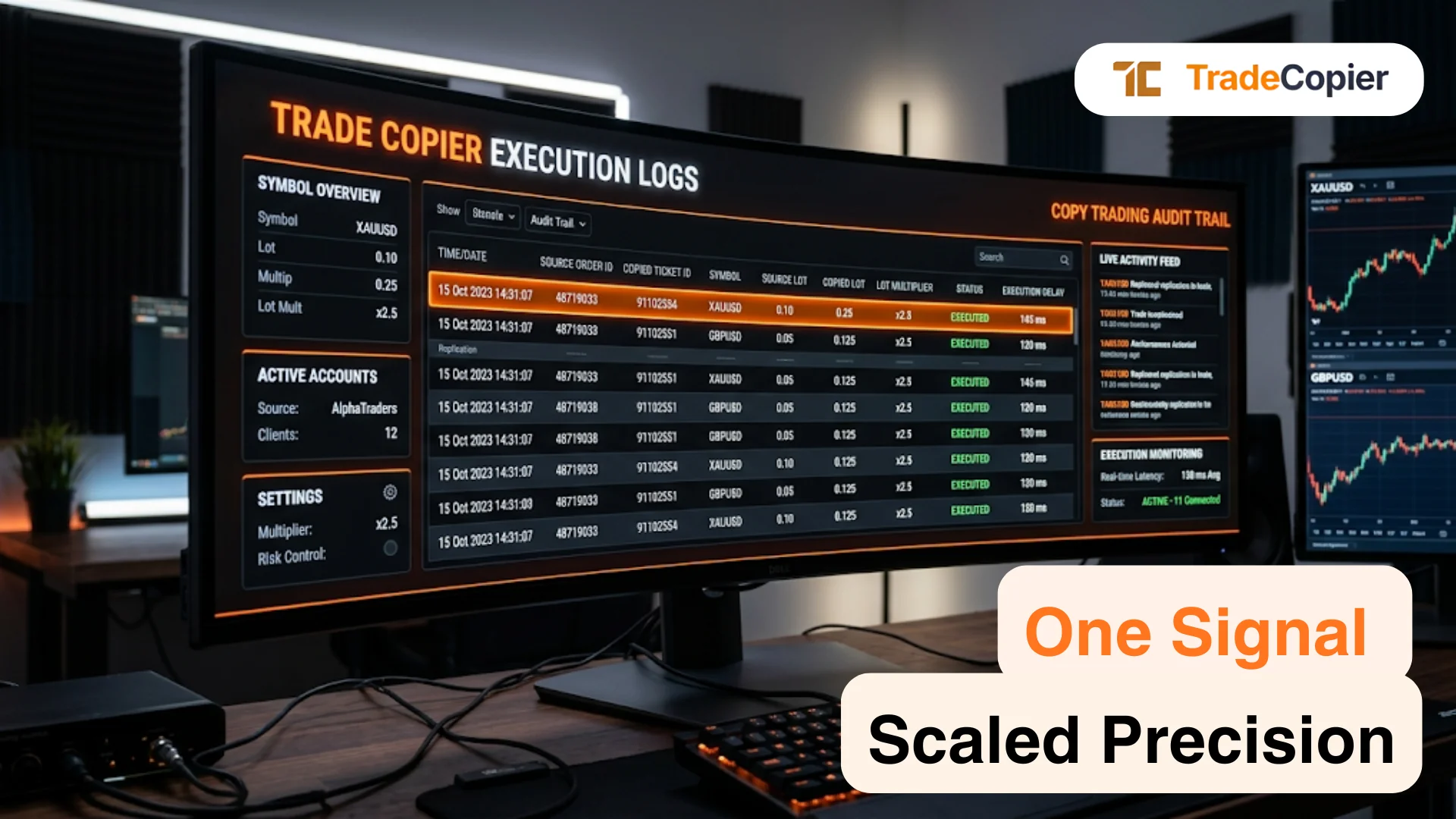
Execution logs reveal latency, rejected orders, and slippage patterns. Reviewing these logs daily helps identify configuration issues before they affect multiple accounts. Source 2 advises checking execution speeds and stop-loss mirroring during testing.
Alerts for drawdown thresholds and consistency-rule proximity allow preemptive action. Setting warning levels at 70 percent and 85 percent of each limit provides time to intervene without triggering firm violations.
What testing steps confirm a trade copier setup works correctly?
A systematic test protocol verifies replication before live deployment. Basic entry replication, stop-loss modification, and full close tests confirm core functions. Partial-close and order-modification tests check proportionate behavior across followers.
Risk-rule tests simulate daily-loss-limit breaches on one follower only. The copier should auto-flatten and lock that account without affecting others. Consistency-rule alerts must fire at the configured threshold. Source 1 outlines a ten-step trial protocol covering these scenarios.
News-event simulations and latency measurements round out testing. Placing trades during volatile periods verifies acceptable slippage. Recording timestamps from copier logs confirms replication speed stays within expected ranges.
- Prop firm rules on daily loss limits and drawdown must be documented before copier configuration.
- Per-account risk settings prevent one follower from breaching its own thresholds.
- Position reconciliation and daily log review catch divergence between master and followers.
- Systematic testing of entry, modification, and risk triggers occurs on demo accounts first.
- Symbol mapping and contract ratios require verification when mixing full-size and micro instruments.
How should readers verify this before acting?
Treat this trade copier checklist article as a verification checklist rather than a promise of outcomes. Read Source 1, Source 2, and Source 3 alongside the site's current setup notes, then separate documented facts, vendor terms, and community observations before making an operational change. The practical review should name what is known from the cited material, what still depends on the reader's configuration, and what must be checked again after publication.
Before acting, write down the assumption being tested, the source that supports it, the risk if it is wrong, and the rollback step. Compare Source 4 and Source 5 with the FAQ and sources list so unsupported shortcuts do not become publishing instructions. Keep the note specific: which setting, workflow, compliance point, or editorial claim needs review; who owns the follow-up; and which source should be reopened if the page is updated later.
The final pass should also check internal links, visible author context, image alt text, schema fields, and whether every recommendation is framed as a documented consideration rather than a universal rule. This keeps the page useful for readers and easier for the Super Admin verifier to audit.
What should be checked before changes go live?
Treat this trade copier checklist article as a verification checklist rather than a promise of outcomes. Read Source 1, Source 2, and Source 3 alongside the site's current setup notes, then separate documented facts, vendor terms, and community observations before making an operational change. The practical review should name what is known from the cited material, what still depends on the reader's configuration, and what must be checked again after publication.
Before acting, write down the assumption being tested, the source that supports it, the risk if it is wrong, and the rollback step. Compare Source 4 and Source 5 with the FAQ and sources list so unsupported shortcuts do not become publishing instructions. Keep the note specific: which setting, workflow, compliance point, or editorial claim needs review; who owns the follow-up; and which source should be reopened if the page is updated later.
The final pass should also check internal links, visible author context, image alt text, schema fields, and whether every recommendation is framed as a documented consideration rather than a universal rule. This keeps the page useful for readers and easier for the Super Admin verifier to audit.
How can the cited evidence be compared?
Treat this trade copier checklist article as a verification checklist rather than a promise of outcomes. Read Source 1, Source 2, and Source 3 alongside the site's current setup notes, then separate documented facts, vendor terms, and community observations before making an operational change. The practical review should name what is known from the cited material, what still depends on the reader's configuration, and what must be checked again after publication.
Before acting, write down the assumption being tested, the source that supports it, the risk if it is wrong, and the rollback step. Compare Source 4 and Source 5 with the FAQ and sources list so unsupported shortcuts do not become publishing instructions. Keep the note specific: which setting, workflow, compliance point, or editorial claim needs review; who owns the follow-up; and which source should be reopened if the page is updated later.
The final pass should also check internal links, visible author context, image alt text, schema fields, and whether every recommendation is framed as a documented consideration rather than a universal rule. This keeps the page useful for readers and easier for the Super Admin verifier to audit.
What should be documented after the review?
Treat this trade copier checklist article as a verification checklist rather than a promise of outcomes. Read Source 1, Source 2, and Source 3 alongside the site's current setup notes, then separate documented facts, vendor terms, and community observations before making an operational change. The practical review should name what is known from the cited material, what still depends on the reader's configuration, and what must be checked again after publication.
Before acting, write down the assumption being tested, the source that supports it, the risk if it is wrong, and the rollback step. Compare Source 4 and Source 5 with the FAQ and sources list so unsupported shortcuts do not become publishing instructions. Keep the note specific: which setting, workflow, compliance point, or editorial claim needs review; who owns the follow-up; and which source should be reopened if the page is updated later.
The final pass should also check internal links, visible author context, image alt text, schema fields, and whether every recommendation is framed as a documented consideration rather than a universal rule. This keeps the page useful for readers and easier for the Super Admin verifier to audit.
This article is for general information only and is not financial advice. Trading, automation, and broker decisions involve capital at risk, risk of loss, and possible loss of capital. Past performance, simulated examples, and backtest references are not indicative of future results.
Frequently asked questions
What is the first item on a trade copier checklist?
Reviewing each prop firm's specific rules on loss limits, drawdown, and consistency comes first. These parameters determine the copier settings that keep accounts compliant. Source 3
Why test a trade copier on demo accounts?
Demo testing reveals configuration errors and rule-violation risks before live capital is exposed. Two weeks of varied market conditions including news events is commonly recommended. Source 5
How often should copier logs be reviewed?
Daily review of execution logs and position states identifies slippage or reconciliation issues promptly. Weekly deeper audits help maintain long-term alignment across accounts.
Sources
- https://copilink.com/articles/complete-prop-firm-trade-copier-buyers-guide-2026 — Copilink, educational, 2026-02-22, retrieved 2026-07-03
- https://www.quantvps.com/blog/how-to-set-up-trade-copying-in-ninjatrader-complete-guide — QuantVPS, educational, 2025-04-08, retrieved 2026-07-03
- https://copilink.com/articles/prop-firm-safe-trade-copier-setup-guide-2026 — Copilink, educational, 2026-02-22, retrieved 2026-07-03
- https://www.fxfundmanagers.com/how-to-use-a-trade-copier/ — FX Fund Managers, educational, 2025-03-25, retrieved 2026-07-03
- https://www.mt4copier.com/manage-prop-trading-accounts-trade-copying/ — MT4Copier, educational, 2026-03-24, retrieved 2026-07-03
Trade Copier Team
Expert guides on trade copying, forex automation, and platform integrations.