Copy trading depends on speed. Even a delay of a few milliseconds can cause copied trades to enter at different prices, resulting in slippage, inconsistent performance, and reduced confidence among followers.
Understanding Trade Copier Trade Delays is essential for traders, money managers, brokers, and prop firms looking to maintain accurate trade replication. While no copy trading environment can completely eliminate latency, a well-designed trade copier can significantly reduce delays and improve execution consistency.
This guide explains what causes trade delays, how they affect copied trades, and which features help minimize latency for more reliable trade copying.
What Are Trade Copier Trade Delays?
Trade Copier Trade Delays refer to the time gap between a trade being executed on the master account and the same trade being placed on follower accounts.
This delay can range from a fraction of a second to several seconds depending on the trading environment, network quality, broker execution, and copier configuration.
Although small delays may seem insignificant, they become increasingly important when trading:
- Scalping strategies
- High-frequency systems
- Volatile market events
- News trading sessions
- Large groups of follower accounts
The lower the delay, the closer follower accounts remain to the master's execution.
Why Delayed Trade Copying Matters
Delayed trade copying directly impacts execution quality.
When markets move rapidly, even a slight delay can lead to:
- Different entry prices
- Increased slippage
- Missed profit opportunities
- Larger stop-loss distances
- Reduced strategy consistency
- Different overall account performance
For brokers managing multiple investors or traders copying professional strategies, minimizing execution delay becomes an important operational objective rather than simply a technical improvement.
Common Causes of Copy Trade Latency
Several factors contribute to copy trade latency. Understanding them helps identify where improvements can be made.
Network Latency
Poor internet connectivity increases communication time between the source and destination accounts.
Examples include:
- Slow internet connections
- High ping
- Packet loss
- VPN routing delays
Broker Execution Speed
Even if the trade copier transmits trades instantly, the receiving broker still needs to process the order.
Execution times vary depending on:
- Broker infrastructure
- Liquidity providers
- Market conditions
- Server load
Server Distance
Physical distance between trading servers affects transmission speed.
For example:
- Source server in London
- Destination server in New York
The greater the distance, the higher the network latency.
Multiple Destination Accounts
Copying trades to many accounts simultaneously increases processing requirements.Modern trade copiers optimize this process through efficient execution management rather than copying accounts one at a time.
Local Computer Performance
If the trading terminal is running on an overloaded VPS or desktop, delays may occur because:
- CPU usage is high
- Memory is exhausted
- Trading terminal freezes
- Background applications consume resources
How Trade Copier Execution Speed Improves Results
Good trade copier execution speed helps maintain consistency between master and follower accounts. Fast execution offers several benefits:
- Reduced slippage
- Better price synchronization
- Improved strategy consistency
- More accurate position replication
- Greater confidence for investors
- Stable performance during active market sessions
While market conditions will always influence execution, reducing unnecessary system delays improves overall copy trading quality.
Features That Help Reduce Copy Trading Delay
An efficient trade copier includes features specifically designed to reduce copy trading delay without adding unnecessary complexity. Important capabilities include:
Optimized Trade Processing
Efficient trade processing ensures orders are detected and transmitted as quickly as possible.
Cloud-Based Architecture
Cloud infrastructure minimizes dependency on a single local machine, improving reliability and reducing interruption risks.
Stable Connection Monitoring
Continuous monitoring helps identify communication interruptions before they affect trade synchronization.
Intelligent Retry Mechanisms
Temporary connection failures should automatically trigger retransmission attempts instead of silently skipping trades.
Flexible Account Management
Efficient handling of multiple destination accounts allows trades to be copied consistently without unnecessary processing bottlenecks.
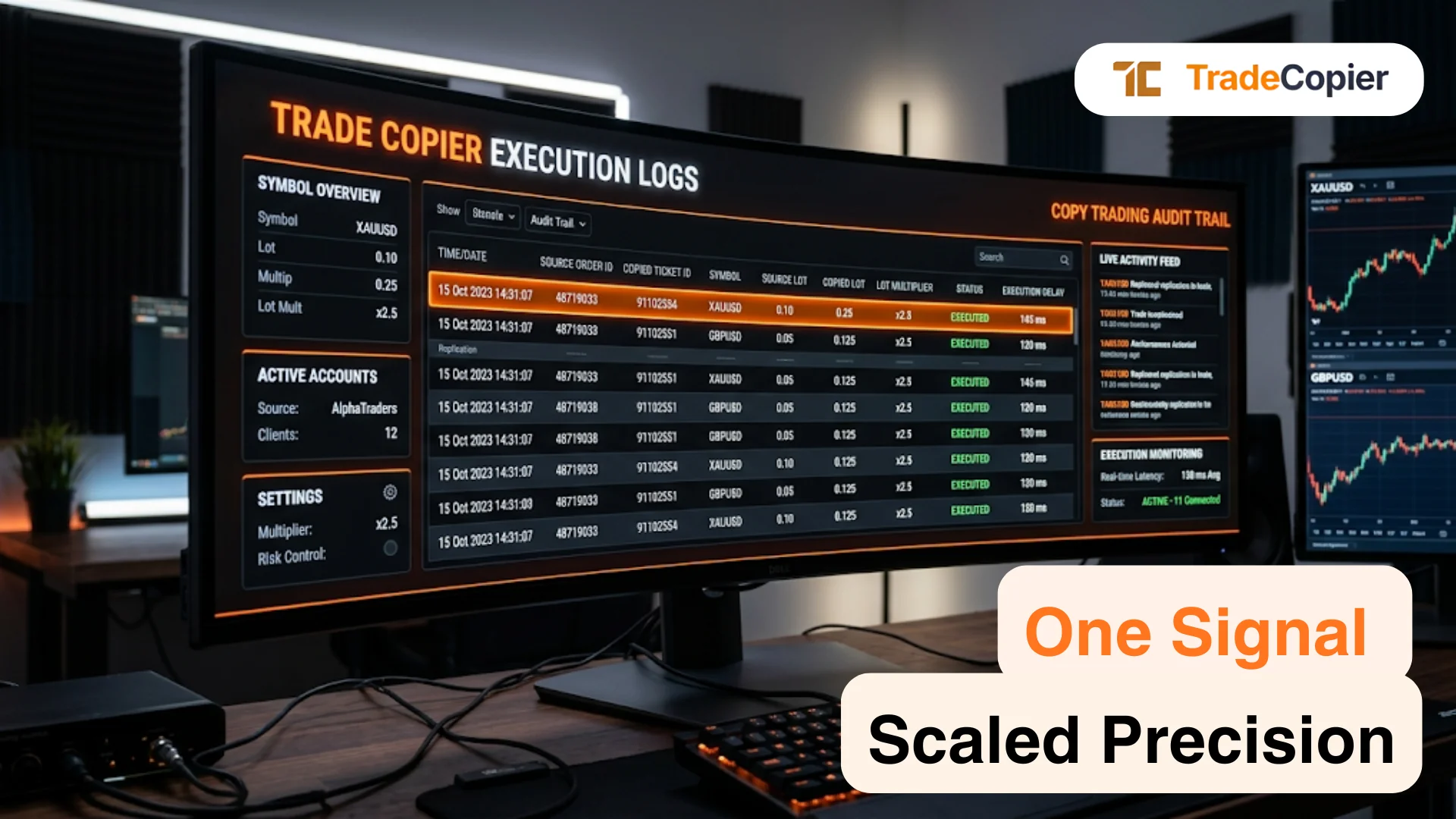
Execution Logs
Detailed execution logs allow administrators to:
- Monitor copied trades
- Detect synchronization issues
- Identify execution delays
- Troubleshoot connection problems
Best Practices to Minimize Trade Copier Trade Delays
Reducing latency requires both reliable software and good infrastructure. Recommended practices include:
- Use a reliable VPS located near broker servers.
- Maintain a stable, low-latency internet connection.
- Keep trading platforms updated.
- Avoid overloading trading terminals with unnecessary indicators or expert advisors.
- Monitor execution logs regularly.
- Verify account connectivity before live trading sessions.
- Use optimized copier settings suitable for the number of follower accounts.
- Test configurations before deploying them to production environments.
Following these practices helps maintain consistent trade synchronization across accounts.
Why Execution Reliability Matters More Than Raw Speed
Many traders focus only on milliseconds. However, reliability often matters more than achieving the absolute fastest execution. A dependable trade copier should consistently:
- Detect new trades quickly.
- Maintain stable account connections.
- Replicate modifications accurately.
- Synchronize stop-loss and take-profit changes.
- Handle large account groups efficiently.
- Recover gracefully from temporary network interruptions.
Consistent execution creates predictable trading outcomes and reduces operational risk for traders and brokers alike.
Conclusion
Understanding Trade Copier Trade Delays helps traders make informed decisions about their copy trading infrastructure. While network conditions, broker execution, and market volatility all influence latency, modern copy trading solutions can significantly reduce unnecessary delays through optimized trade processing, stable connectivity, and efficient execution management.
Choosing a trade copier that prioritizes execution reliability, monitoring, and scalable performance helps maintain consistent trade synchronization across multiple accounts while improving the overall copy trading experience.
Start your copy trading journey at tradecopier.org.
Frequently Asked Questions
What causes Trade Copier Trade Delays?
Trade delays are commonly caused by network latency, broker execution time, server distance, computer performance, and the number of destination accounts being synchronized.
Can copy trade latency be completely eliminated?
No. Some latency is unavoidable because of network communication and broker execution. However, a well-optimized trade copier can minimize delays significantly.
Does delayed trade copying affect profitability?
It can. Delays may result in different entry prices, increased slippage, and inconsistent trade performance, especially during volatile market conditions.
How can traders reduce copy trading delay?
Using a reliable VPS, maintaining stable internet connectivity, optimizing platform performance, monitoring execution logs, and using an efficient trade copier all help reduce latency.
Why is trade copier execution speed important?
Faster execution improves price synchronization, reduces slippage, and helps follower accounts more accurately replicate the master account's trading activity.
Trade Copier Team
Expert guides on trade copying, forex automation, and platform integrations.